About QUP
Research
Members
Job Openings - Jp Page HOMENews
Inquiry & Access
Links
For QUP members
Code of Conduct


About QUP
Research
Members
Job Openings - Jp Page HOMEAbout QUP
Research
Members
Job Openings
Jp Page HOME


News
Topics
February 6, 2026
Collaboration between QUP experimentalists and theorists proposes dark matter searches with superconducting TES detectors
Researchers at the International Center for Quantum-field Measurement Systems for Studies of the Universe and Particles (WPI-QUP), hosted by the High Energy Accelerator Research Organization (KEK), have proposed how superconducting transition-edge sensor (TES) quantum detectors could sensitively probe particle dark matter (DM) in underexplored regimes.
DM is thought to make up approximately 85% of all matter in the Universe, yet its fundamental nature remains unknown. The study, published in Physical Review D, was carried out by QUP researcher Muping Chen together with QUP Principal Investigators Volodymyr Takhistov, Kazunori Nakayama and Kaori Hattori. It systematically established how ultra-sensitive quantum sensors with sub-electron-volt (sub-eV) energy resolution, including optical TES detectors originally developed for precision photon detection by PI Hattori and her collaborators, can probe novel interactions of DM with masses below the GeV scale. Detection principle of DM material interactions using TES is illustrated in Fig. 1.

Figure 1: Conceptual illustration of DM-material interactions generating quasiparticle excitations
in superconducting materials, which are measured using TES.
The study combines detector response modeling with detailed theoretical calculations of DM interactions in materials. By connecting realistic sensor performance to theoretical models of DM interactions, the research provided a comprehensive framework for DM searching strategy, assessing the potential role of TES-based detectors alongside other quantum sensor and astroparticle detection strategies being explored worldwide. Representative results from the analysis showcasing sensitivity to DM-electron interactions are illustrated in Fig. 2. This demonstrates that the experiments with TES detectors could extend the search area in the sub-MeV DM mass region. This leverages recent advances in detector development at QUP and elsewhere, highlighting how such technologies could be extended to future DM search endeavors.
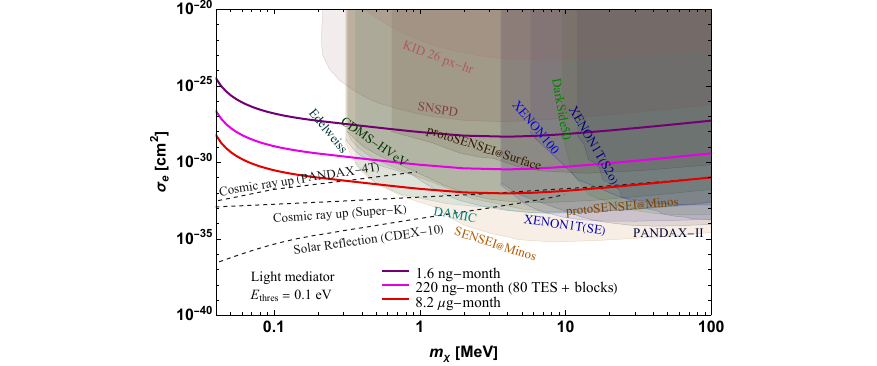
Figure 2: Representative sensitivity for TES-based detection of DM-electron scattering from the analysis, illustrating the framework. The solid lines show the sensitivity with the TES-based experiments, and the shaded regions indicate existing constraints derived from other experiments. The TES-based experiments can extend the search coverage for DM in the lighter mass range.
QUP conducts experimental efforts to explore low-background quantum sensors with international partners. QUP is planning DM search experiments with the high resolution quantum detectors in quiet underground environments, such as in Kamioka mine in Japan.
“This study illustrates the importance of close collaboration between theory and experiment,” said Takhistov. “Theoretical modeling helps identify where emerging detector technologies can offer complementary sensitivity and how they fit into the broader global effort to search for dark matter and new fundamental physics.”
This work highlights QUP’s mission of advancing fundamental physics through quantum measurement science and of fostering interdisciplinary, internationally visible research at the interface of fields as well as theory and experiment.
Published details
Journal: Physical Review D 113, 036006
Title: Light Dark Matter Detection with Sub-eV Transition-Edge Sensorsbr
Authors: Muping Chen (1), Volodymyr Takhistov (1,2,3,4), Kazunori Nakayama (5,1), Kaori Hattori (1)
DOI: https://doi.org/10.1103/74pr-jb4t
Author affiliations:
1 International Center for Quantum-field Measurement Systems for Studies of the Universe and Particles (QUP, WPI), High Energy Accelerator Research Organization (KEK), Oho 1-1, Tsukuba, Ibaraki 305-0801, Japan
2 Theory Center, Institute of Particle and Nuclear Studies (IPNS), High Energy Accelerator Research Organization (KEK), Tsukuba 305-0801, Japan
3 Graduate University for Advanced Studies (SOKENDAI), 1-1 Oho, Tsukuba, Ibaraki 305-0801, Japan
4 Kavli Institute for the Physics and Mathematics of the Universe (WPI), UTIAS, The University of Tokyo, Kashiwa, Chiba 277-8583, Japan
5 Department of Physics, Tohoku University, Sendai, Miyagi 980-8578, Japan
Media contact
QUP Strategy Office
Email: qup_pr-at-kek.jp
* Please change _at_ to @