
- Topics
Report on the 2nd AI+HEP in East Asia Workshop
February 24th, 2026
-
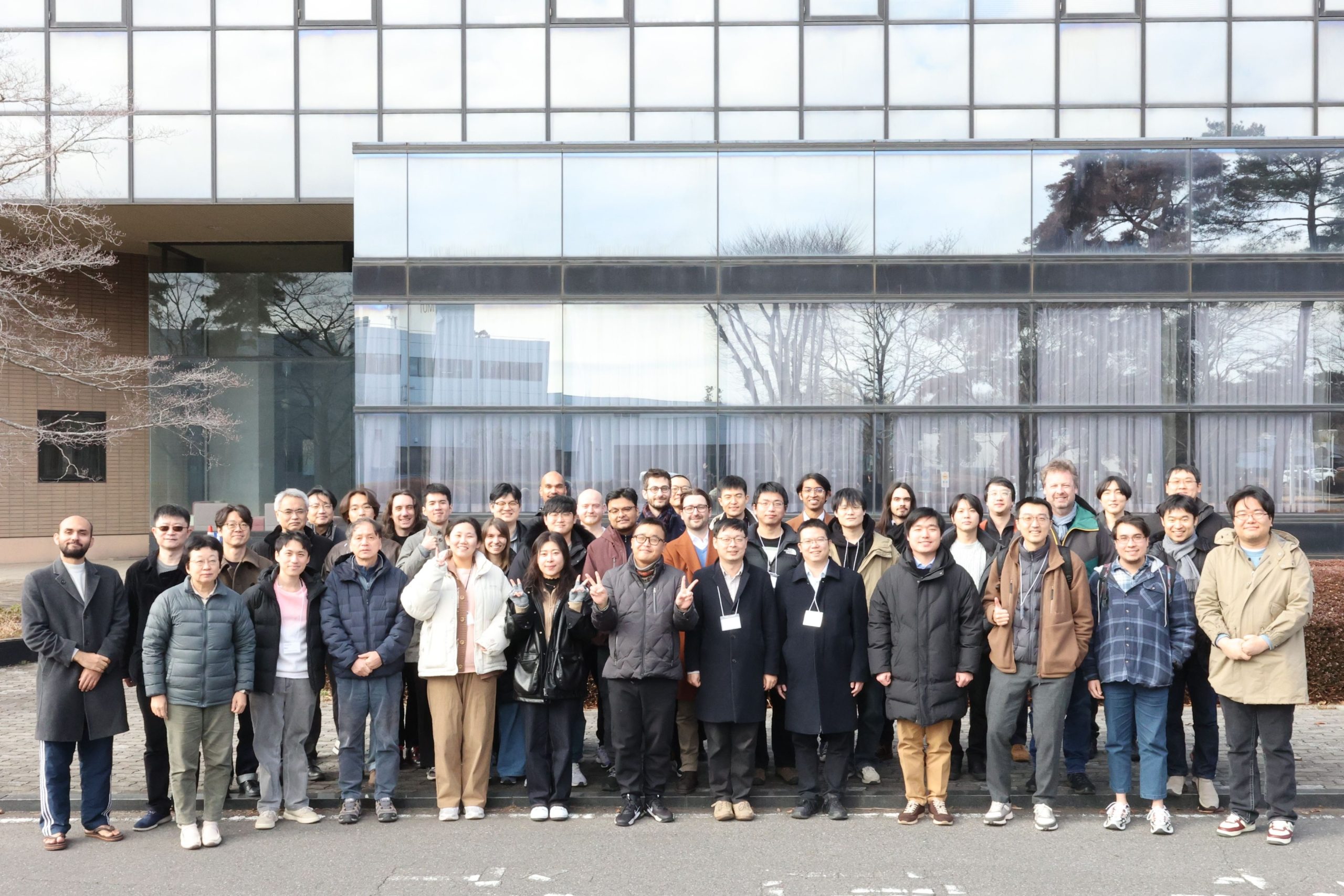
The 2nd AI+HEP group photo
An international workshop, “The 2nd AI+HEP in East Asia,” was held to bring together researchers from East Asia to discuss current and emerging uses of artificial intelligence (AI) in high-energy physics (HEP).
Workshop Overview
The 2nd AI+HEP in East Asia, held from January 19 to 23, 2026, gathered researchers mainly from East Asia to exchange views on recent developments and future directions of AI in high-energy physics. The workshop was conducted in a hybrid format and was attended by 87 participants from more than 60 institutions across over 10 countries and regions.
In high-energy physics, the use of AI has increased steadily in recent years, and a growing number of international meetings now address this topic. At the same time, collaboration within the Asian region has not always been well established. The AI+HEP in East Asia workshop series was initiated to encourage closer interaction among researchers in the region and to provide a forum for sustained discussion.
The Role of AI in High-Energy Physics
According to databases such as INSPIRE, the number of publications related to AI in high-energy physics grew from around 50 papers in 2018 to more than 400 papers in 2025. AI has thus become an important component of research in the field.
In experimental studies, AI is used for tasks such as identifying particles from detector signals and searching for rare or unusual events. It is also applied to calculations related to particle interactions, spacetime structures, and the analysis of gravitational-wave data. In addition, recent progress in large language models has led to interest in research frameworks in which multiple AI systems are used together across different stages of research, including theoretical work, numerical calculations, and data analysis. As AI systems continue to improve their ability to handle logical tasks, some researchers have begun to consider the possibility that AI may contribute directly to the development of new theoretical ideas. The workshop offered participants an opportunity to review these developments and to discuss their implications for future research.
The AI+HEP in East Asia workshop series is expected to continue as a regular forum for strengthening connections between AI research and high-energy physics in East Asia.
Handover Ceremony for ACAT2027
During the workshop, a handover ceremony was held in preparation for ACAT2027, the 24th International Conference on Advanced Computing and Analysis Techniques in Physics Research, which is scheduled to take place in Tokyo in March 2027. ACAT2027 will be organized by a joint committee formed by Tokyo City University, the University of Tokyo, and KEK.
The ACAT conference series was originally launched under the name AIHENP (Artificial Intelligence for High Energy and Nuclear Physics). At the second meeting in 1992, a talk entitled “World-Wide Web: an information infrastructure for high energy physics” was presented by Dr. Tim Berners-Lee, one of the developers of the World Wide Web.
-
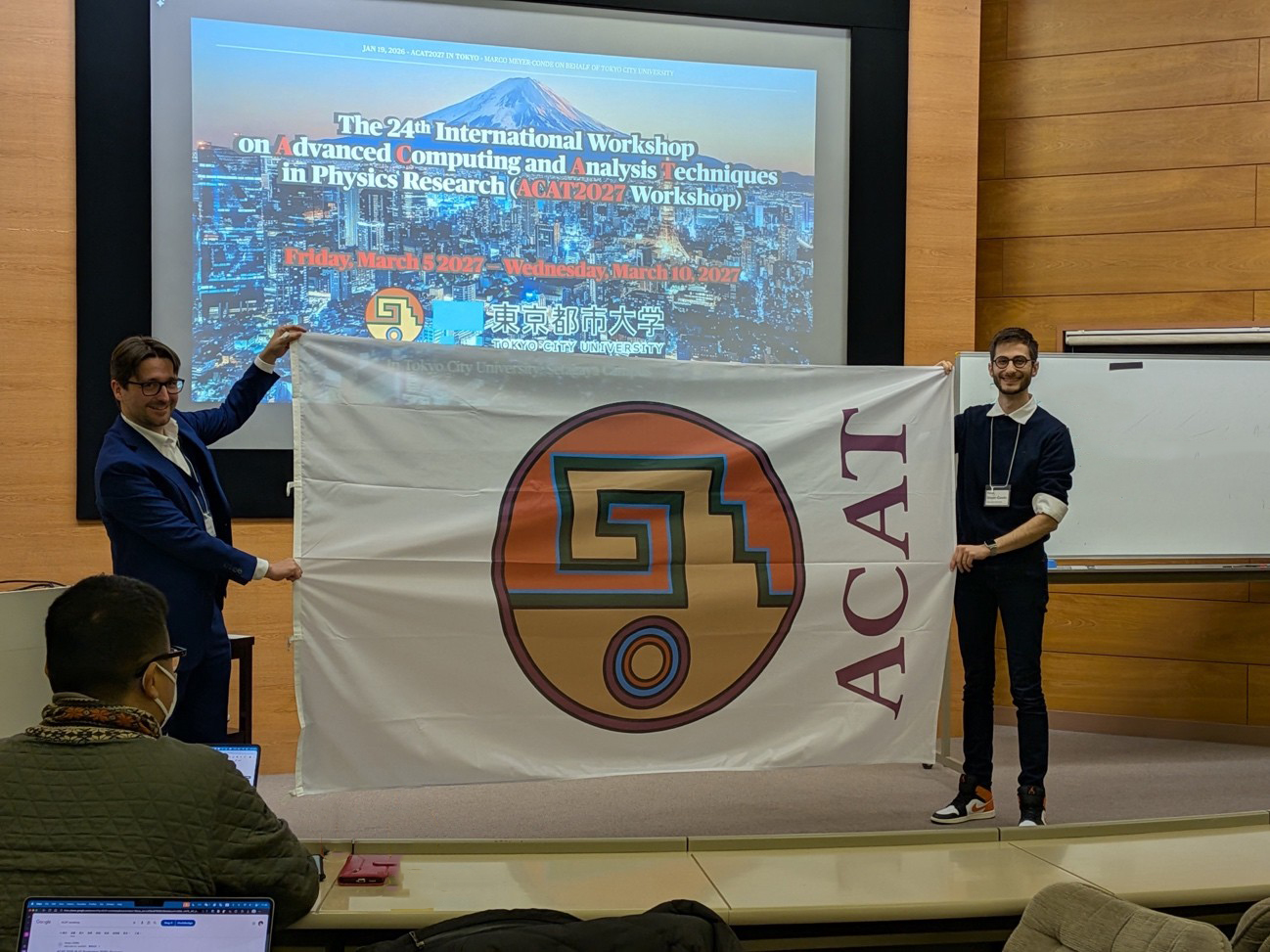
ACAT flag handover at the 2nd AI+HEP. Left: Previous workshop chair Professor Gregor Kasieczka.
[The ACAT Logo]
The design shown on the conference flag has been used since the first ACAT meeting. It is based on a stylized representation of an Aztec feathered shield. The logo reflects the idea expressed in the phrase “how to get out of this maze without re-inventing the wheel,” which points to the importance of sharing knowledge across different areas of expertise and avoiding unnecessary duplication of effort in computational research for particle physics.
Note:
Aztec shields (chimalli) were made by attaching bird feathers to a wooden base and were used both in warfare and in ceremonial contexts. The shield that served as the model for the conference logo is an original 16th-century artifact preserved at the Landesmuseum Württemberg in Germany. It features stepped patterns and circular motifs representing the sun.
Learn more here.




.jpg)