About QUP
Research
Members
Job Openings - Jp Page HOMENews
Inquiry & Access
Links
For QUP members
Code of Conduct


About QUP
Research
Members
Job Openings - Jp Page HOMEAbout QUP
Research
Members
Job Openings
Jp Page HOME


Research
Research Overviews
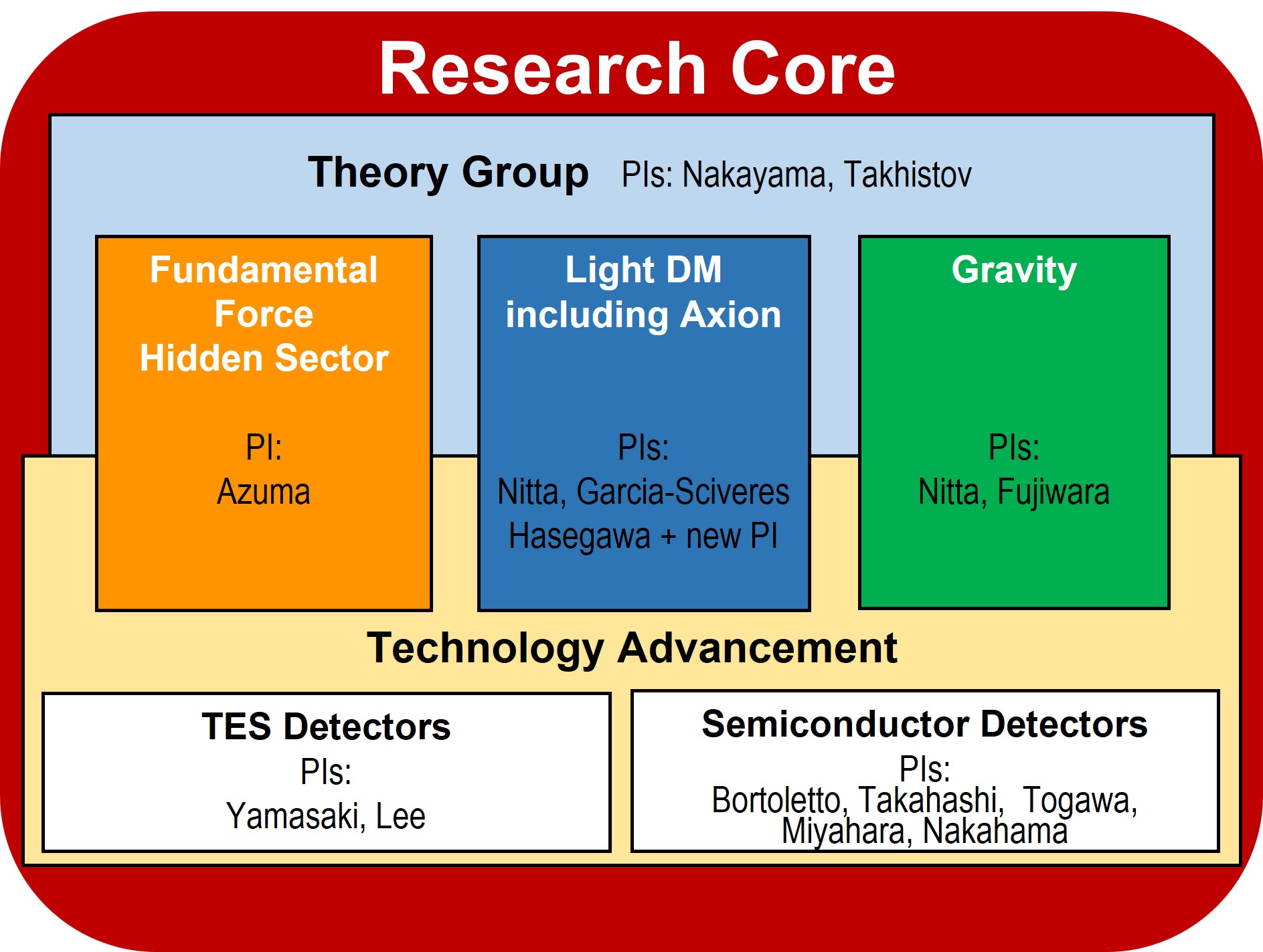
We tackle some of the most compelling open questions in modern physics through our three research pillars with the integrated collaboration between quantum sensor development and dedicated theory. A cross-functional, execution-oriented governance model aligning scientific strategy, technology advancement, and robust administrative support.
Pillar I
Fundamental Forces and Hidden Sectors
Precision tests of established theories under extreme conditions to seek breakdowns of QED, QCD, and new physics beyond the Standard Model. The primary focus is high-resolution spectroscopy of muonic atoms using intense muon beams at KEK/J-PARC combined with cutting-edge superconducting TES microcalorimeters. This unique setup allows us to probe bound-state QED under the strongest electromagnetic fields in nature (approaching the Schwinger limit of 1018 V/m).
■ Resolve the 100 eV QED contribution in 44 keV muonic X-rays with unprecedented ~0.1 eV precision.
■ Explore hidden sectors, including searches for MeV-scale dark photons and axion-like particles.
■ Foster tight integration between detector experts and theorists to refine target observables.
Pillar II
Light Dark Matter, Including Axions
Pioneering complementary approaches to detect ultra-weak signals in unexplored low-mass parameter spaces (μeV to meV scale), which may account for the majority of dark matter in the universe. QUP leverages distinct quantum sensing architectures to aggressively map these theoretical blind spots.
■ Superconducting Qubits & Cavities: Developing highly sensitive, magnetic-field-tolerant architectures to detect ultra-weak electromagnetic signals from axion conversions.
■ Kamioka Low-mass Dark Matter Search: Leveraging the ultra-low background environment of the Kamioka underground observatory with arrays of cryogenic TES detectors.
■ NV-centers in Diamond: Advancing quantum sensing approaches that exploit electron and nuclear spins for directional dark matter detection.
Pillar III
Gravity
Opening entirely new observational windows to explore the most elusive and weakly coupled force in nature: gravity. By adapting KEK's world-leading accelerator technologies and partnering with international facilities, we aim to push the boundaries of gravitational physics and test fundamental symmetries.
■ High-Frequency GW Detection: Utilizing advanced superconducting RF cavities (achieving ultra-high Q-factors) to probe gravitational waves in the unexplored kHz-to-GHz high-frequency regime.
■ Antimatter Gravity Studies: Conducting precision studies of antihydrogen at TRIUMF using atomic fountains and interferometry to test the Weak Equivalence Principle and CPT invariance.
■ Cross-disciplinary Metrology: Applying these extreme sensitivity requirements back to the development of next-generation quantum sensors.
As the foundation supporting the three scientific research pillars of this hub, we are establishing a theoretical group and a technology advancement platform.
TH
Defining target observables, guiding sensitivity studies, and ensuring coherence across all experiments to integrate quantum metrology with particle physics.
Underlying our scientific pillars is a horizontal platform centered on detector development. It enables rapid prototyping, system integration, and cross-pillar technology transfer.
SuperD
Superconducting Detectors
Establishing a comprehensive, independent domestic R&D capability for Transition-Edge Sensors (TES). By constructing a dedicated research platform at KEK and collaborating tightly with the JAXA and UC Berkeley satellite offices, QUP drives the end-to-end process: from sensor patterning and microfabrication to cryogenic characterization.
■ End-to-end development of high-resolution TES microcalorimeters optimized for precision particle physics.
■ Direct application to extreme-environment experiments, including muonic atom spectroscopy at J-PARC.
■ Deployment of ultra-low background cryogenic TES systems for the Kamioka Light Dark Matter project.
SemiD
Semiconductor Detectors, Quantum Imaging, and AI
Pioneering extreme-environment electronics, novel tracking devices (e.g., SOI, LGADs), and next-generation Compton cameras tightly integrated with artificial intelligence. A critical focus is developing Cryo-CMOS ASICs to minimize thermal noise in massive cryogenic readouts, alongside state-of-the-art Deep Learning models that achieve real-time, high-resolution 3D visualization of MeV gamma rays from sparse data.
■ Cryogenic & Tracking Hardware: Cryo-CMOS integration for mK-range heat load limits and high-resolution tracking with advanced Silicon technologies.
■ Quantum Imaging Hardware: High-resolution semiconductor/scintillator arrays and omnidirectional designs for broad-spectrum sensitivity.
■ AI and Edge Computing: AI-assisted autonomous data acquisition combined with end-to-end deep networks (e.g., CNNs, Swin-transformers) for real-time, artifact-free image reconstruction.
■ Broad Applications:A Bridging astrophysics with medical theranostics (BNCT, targeted radionuclide therapy) and environmental monitoring.
CE
Cryogenic Engineering
To advance detector development technology at QUP, we will pursue research and development in cryogenic technology.