
The most important element in social infrastructure structural materials is the understanding and control of fracture mechanisms. Materials cannot be used without safety management. Fracture phenomena have a hierarchical structure from the atomic level to the microscale, and the complexity increases in composite materials because the fracture mechanism differs depending on the time to fracture. The design of structural materials requires the understanding and control of "spatio-temporal multi-scale mechanisms of crack initiation and propagation" from the initial structure of the fracture mechanism to fracture.
In this project, in order to elucidate the static and impact fracture mechanisms of structural materials, (1) time-resolved X-ray measurements using a combination of an intense laser/light gas gun and synchrotron radiation, and (2) nondestructive measurements using X-ray microscopy or neutron black edge method to visualize the interior of materials after fracture will be conducted. (2) visualization of the interior of the material by non-destructive measurement using X-ray microscopy or neutron black-edge method after fracture.
NIWA Yasuhiro, ICHIYANAGI Kouhei, NOZAWA Shunsuke, KIMURA Masao
KAWAI Nobuaki (Kumamoto University)
J. Hu(China Academy of Engineering Physics)
Basic technology for sample environment: High pressure, high temperature (short time)
Pump-probe time-resolved X-ray measurement (TR-XRD, TR-DXAFS, X-ray imaging)
X-ray microscopy (XAFS-CT, STXM, XAS/XRX/XRD, X-CT)
Neutron Bragg edge tomography
Laser measurement (optical interferometry, high-speed imaging)
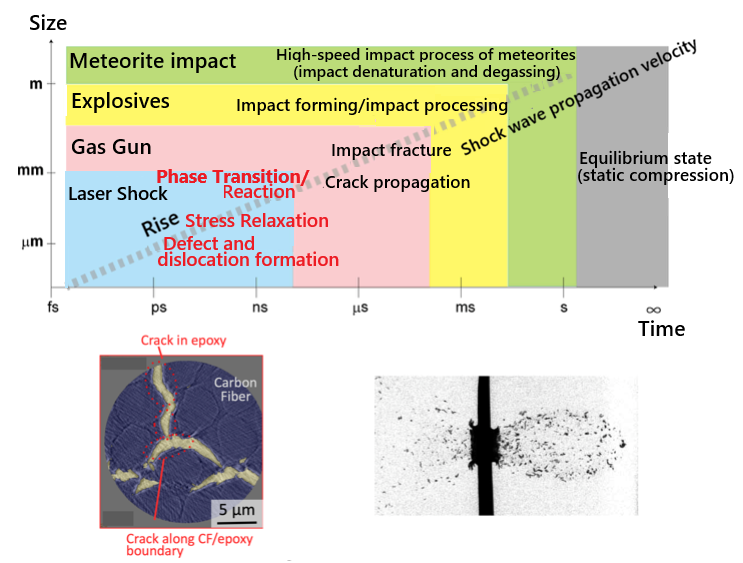 Multi-scale hierarchical structure of impact fracture in space and time
