
- Topics
IPNS Seminar Report: First Measurement of Time-Dependent CP Violation in B Meson Decays into two neutral pions
April 30th, 2026
The Belle II experiment began Run 2 operations in 2024 and has been steadily collecting electron-positron collision data. On March 19, it achieved a new world record for peak luminosity at 5.2 × 1034 cm⁻²s⁻¹ and has accumulated approximately 770 fb⁻¹ of data to date. With the collected data, a large number of physics analyses are currently underway. Among these, the collaboration has recently reported the results of a measurement of time-dependent charge-parity (CP) symmetry violation in the decay process of a B meson into two neutral pions (B → π⁰π⁰). This result is based on a novel method enabled by the nano-beam scheme of the SuperKEKB accelerator and the pixel detector (PXD) of the Belle II experiment.
An IPNS seminar was held on March 31 at the KEK Tsukuba Campus to present this achievement. At the seminar, Kieran Amos from INFN Trieste (Italian National Institute for Nuclear Physics), one of the principal analysts for this study, presented the details of the result.
-
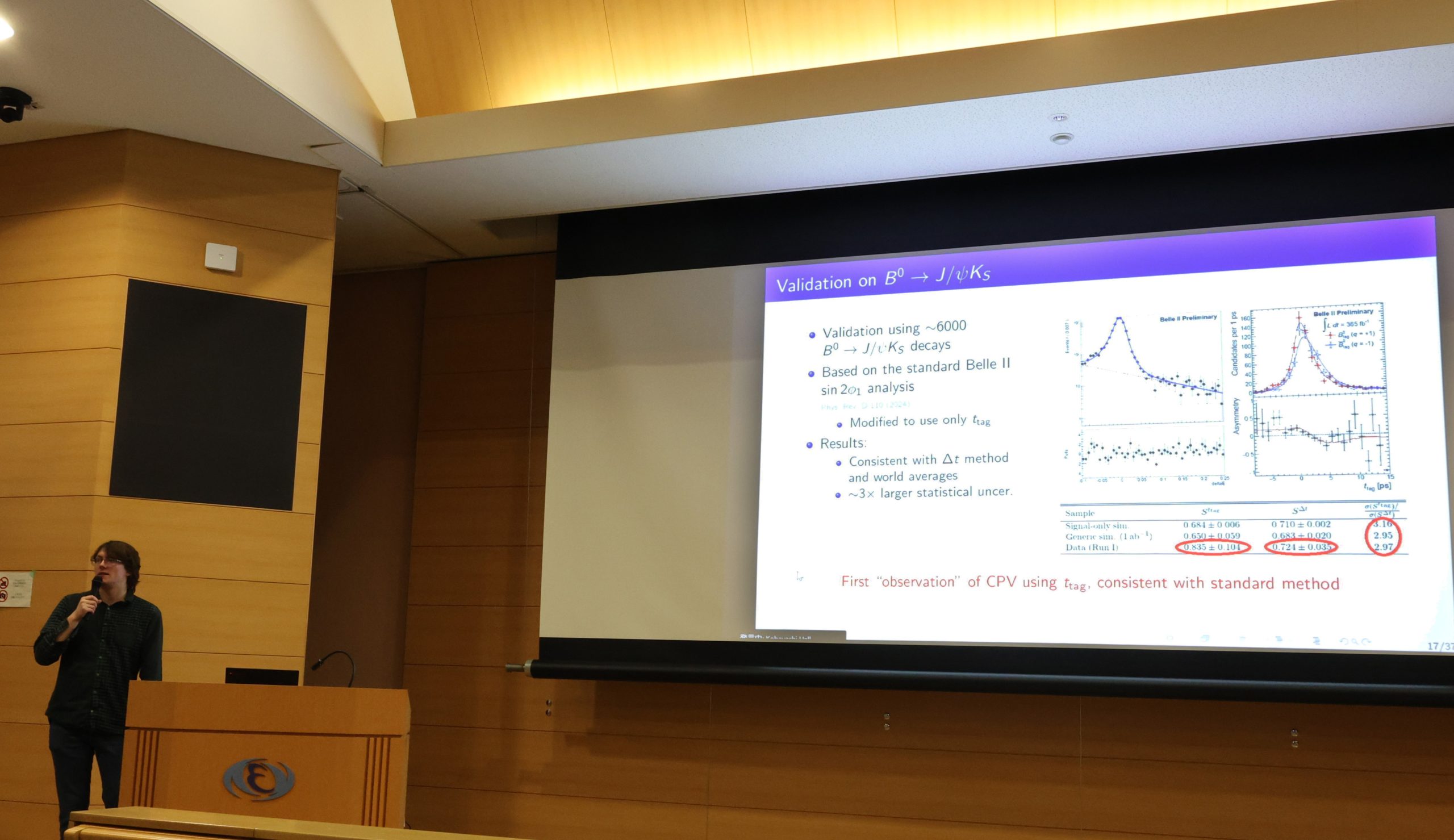
Kieran Amos, speaker
Overview of the Result
The result reported here represents the first measurement of time-dependent CP violation in the decay of a B meson into two neutral pions (B → π⁰π⁰ ), a channel that has long been considered extremely challenging to study. The primary difficulty in this measurement arises from the inability to precisely determine the decay position of the signal B meson.
In general, studies of time-dependent CP violation at B factories require measuring the time difference between the decays of a pair-produced B meson and anti-B meson within the detector. This is typically achieved by reconstructing the decay vertices from the trajectories of charged particles produced in each B meson decay¹ (see Fig. 1, top). However, in the case of the B → π⁰π⁰ decay, the neutral pion (π⁰) predominantly decays into two photons. Since photons do not leave tracks in the detector, the decay vertex cannot be directly reconstructed. For this reason, measuring time-dependent CP violation in the B → π⁰π⁰ channel has conventionally been regarded as extremely difficult².
This challenge has been overcome by a novel idea that exploits quantum entanglement. The B meson and anti-B meson pairs produced at SuperKEKB are in an entangled quantum state, allowing information about one meson to be inferred from the other. Instead of directly reconstructing the decay vertex of B → π⁰π⁰ (the “signal” B meson), which is difficult to measure, this method determines CP-related information indirectly by precisely measuring both the decay vertex and the production point of the other B meson (the “tag-side” B) as illustrated in Fig. 1, bottom.
-
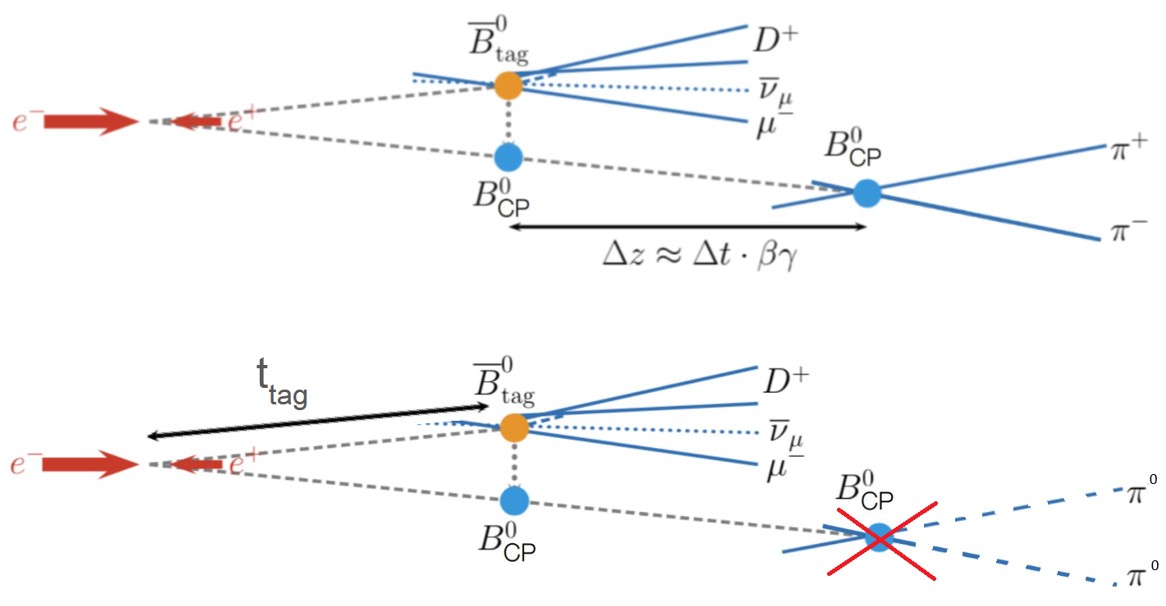
Figure 1: Measurement of time-dependent CP violation at Belle II. Top: Conventional method, in which both the decay vertex of the signal B meson (right side of the black arrow) and that of the opposite-side B meson (tag-side B; left side of the black arrow) are reconstructed. Since the B mesons propagate toward the right after production in this schematic, the decay positions provide information on the decay times. Bottom: New method used in this analysis. In the case of B → π⁰π⁰ decays, the decay vertex of the signal B meson cannot be reconstructed. Instead, the production point (left side of the black arrow) and the decay vertex of the tag-side B (right side of the black arrow) are measured
Nano-Beam Scheme and High-Precision Pixel Detector Enabling the New Method
However, this new approach presents a significant challenge. In accelerators, electron and positron beams circulate in bunches. For example, at the predecessor KEKB accelerator, the interaction region where B meson pairs are produced was spread over a volume comparable to the bunch size, making the production point only roughly determined. Precise knowledge of the B meson pair production point—essential for this new method—has been achieved through the nano-beam scheme of SuperKEKB and the pixel detector of the Belle II experiment.
At SuperKEKB, a “nano-beam scheme” is employed, in which the beams are tightly focused and collided at a large crossing angle (see Fig. 2). This configuration localizes the interaction region to an extremely small volume, enabling a precise determination of the B meson pair production point—and consequently improving the determination of the decay timing of the tag-side B meson.
-
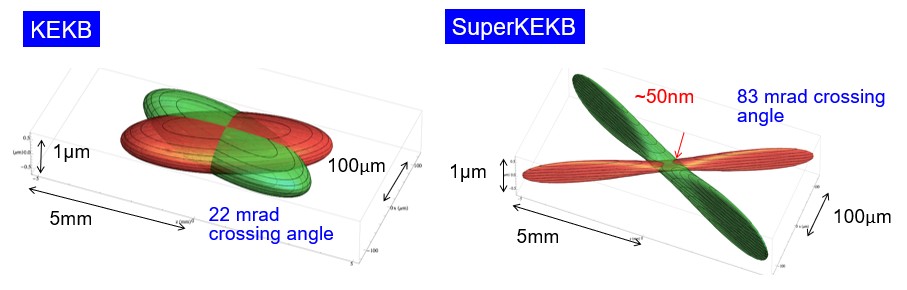
Figure 2: Beam collisions at KEKB and SuperKEKB. Left: At the KEKB accelerator, the crossing angle is smaller, and the bunches are wider than at SuperKEKB, resulting in a larger interaction region. Right: At SuperKEKB, the nano-beam scheme employs a large crossing angle and a small horizontal beam size; the bunches intersect such that collisions occur only in the tightly focused central region
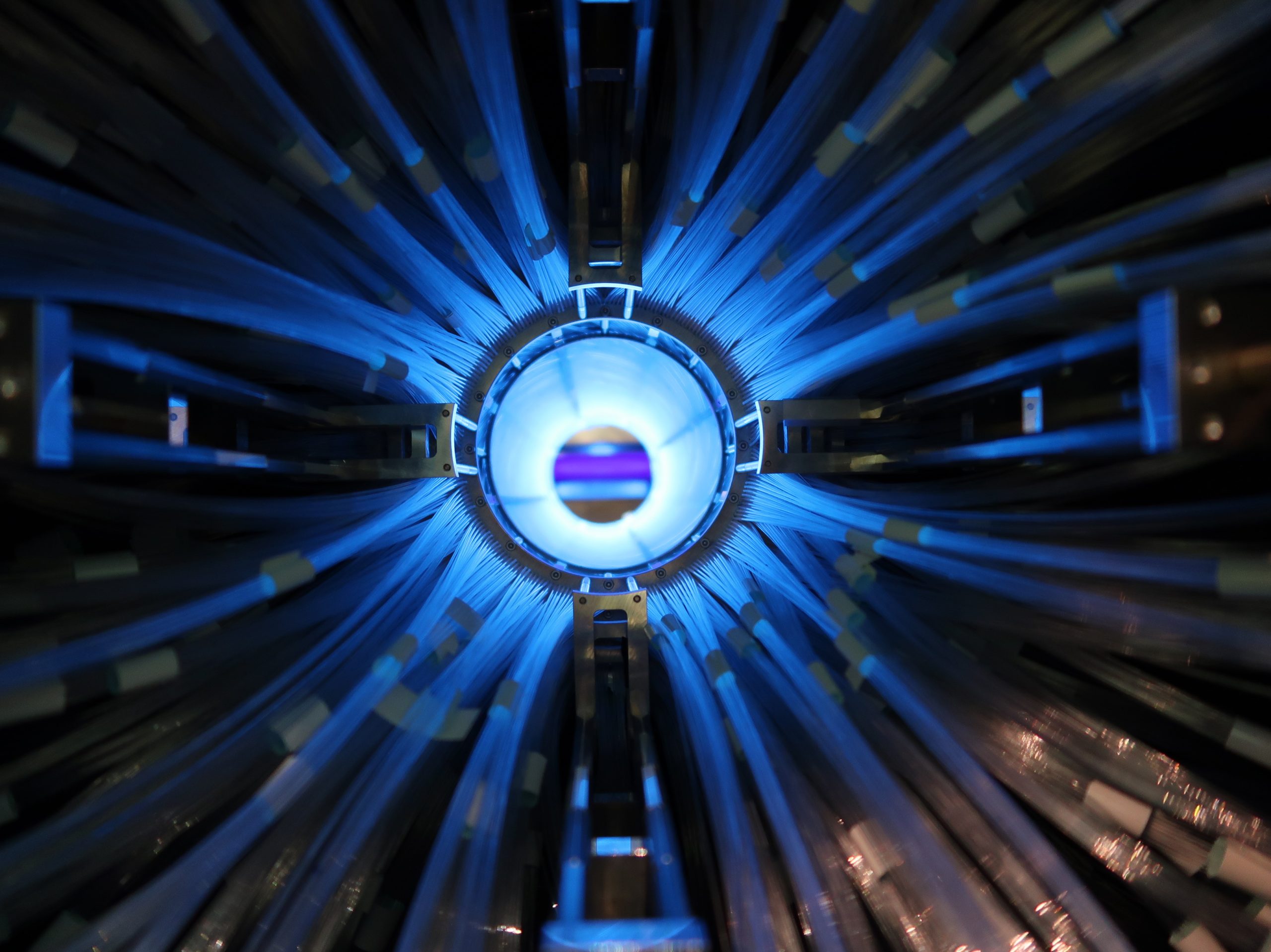
In addition, the pixel detector installed in the Belle II experiment plays an essential role. The PXD, shown at the center of Fig. 3, is a high-resolution detector based on silicon sensors and is positioned extremely close to the beamline, at a distance of only about 14 mm. The excellent spatial resolution enables the decay vertex of the tag-side B meson to be reconstructed with very high precision, significantly improving the accuracy of the time measurement.
-
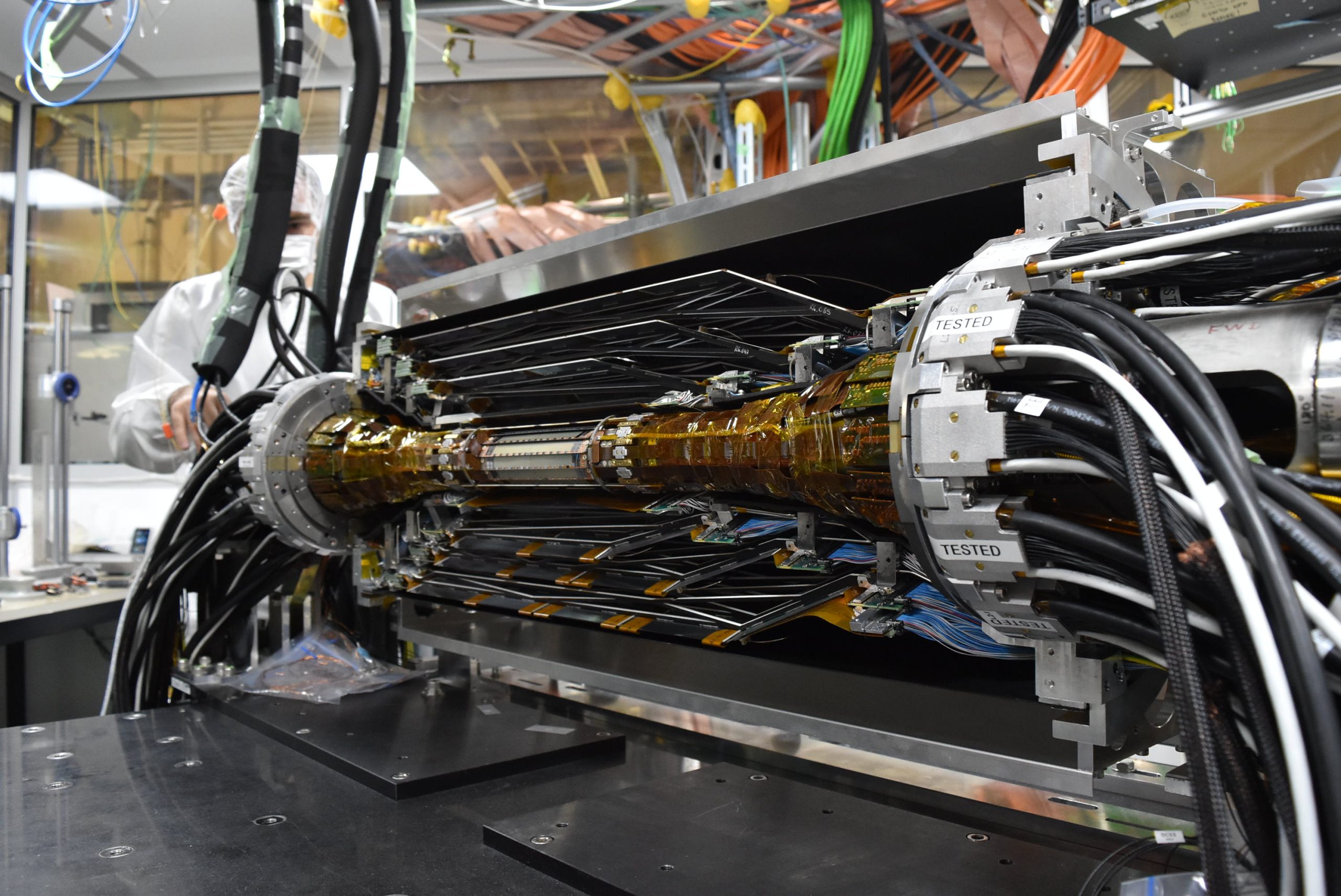
Figure 3: The cylindrical detector at the center is the pixel detector. Installed closest to the interaction point, it improves the vertex resolution by about a factor of two compared to the Belle experiment
We interviewed Kieran:
――Where did this idea come from?
Kieran: This idea was developed in Trieste by our group. After showing our work to colleagues, we did find out that a similar concept had been suggested in 1999 by a CLEO physicist, but it went largely unnoticed, probably because the needed technology wasn’t really available at the time.
――How long did it take to reach this result?
Kieran: We had some initial thoughts already during the measurement of the branching fraction of this rare decay, a couple of years ago. But it took roughly around one year since we first formalized the theoretical idea to now, when we have finalized the measurement.
――What was the most challenging part during the analysis?
Kieran: I guess the most challenging part was just developing and validating the measurement concept based on the tag B decay time, as opposed to all preexisting measurements. That was difficult. Also, in general, the B to π⁰π⁰ decay is quite a difficult state to measure because it has a very small branching ratio, so only around one in a million B mesons decays to this state. So we have very few decays to work with, and we also have a very large background in this case.
――How did you handle the background?
Kieran: We have a number of tools to discriminate against background. One of the most important is what we call the continuum suppressor. Developed within the Belle II experiment, it is an algorithm that essentially tries to distinguish B mesons from the dominant background of collisions producing light quarks, based on the shape of the spatial and energy distributions of the particles recorded in the detector. When collision energy is at threshold to produce just a pair of B mesons, the masses of these B mesons take up the entire energy of the incoming particles, and B mesons are almost stationary. So, when they decay, the emitted particles are spread in all directions in a sphere-like fashion. By contrast, light quarks show collimated spatial shapes because their masses are much smaller than the collision energy, which imparts high speeds to these quarks, so that they tend to spray out back-to-back. So, it’s a very different topology, and Belle II has developed many different variables, many different methods to try and separate these two based on what they look like in the detector.
――What impact has this measurement result on your field, I mean the particle physics community?
Kieran: This measurement is likely to have a transformative impact among particle physicists that study the weak interactions of quarks. Because the studies of the weak interactions represent a sizable fraction of the particle-physics community at large and our results enable new, more efficient ways of probing the Standard Model and its extensions, I expect that the broader impact too will be significant.

Note1:
B mesons produced at the asymmetric-energy SuperKEKB collider are moving at high speed of about 30 percent of the speed of light, and the time difference of the decays can be determined by measuring their decay point difference.
Note2:
About one percent of the neutral pions decay into an electron, a positron, and a photon; in principle, this decay mode could be used for measurement with conventional methods. However, doing so would require more than 20 times the amount of data used in the present analysis.