- Topics
Belle II Physics Week 2026 Explores Hadronic Decays of Beauty and Charm
November 24th, 2026
More than 100 researchers and students gathered at KEK Tsukuba Campus from October 26 to 30 for Belle II Physics Week 2026. Now in its ninth edition, the event brought together Belle II experimentalists, theorists from the wider physics community, and researchers from other major experiments studying heavy quarks, including LHCb and BESIII.
The theme of the 2026 meeting was “Hadronic decays of beauty and charm – from standard to exotic.” Beauty (also known as bottom) and charm are two types of quarks with relatively large masses. Quarks are elementary particles that make up hadrons such as mesons and baryons. Participants discussed the decays of mesons, baryons, and quarkonium containing these quarks, drawing on recent experimental results and theoretical developments. Belle II has published nearly 50 papers related to these topics. The meeting provided an opportunity to review recent findings and identify promising directions for future research.
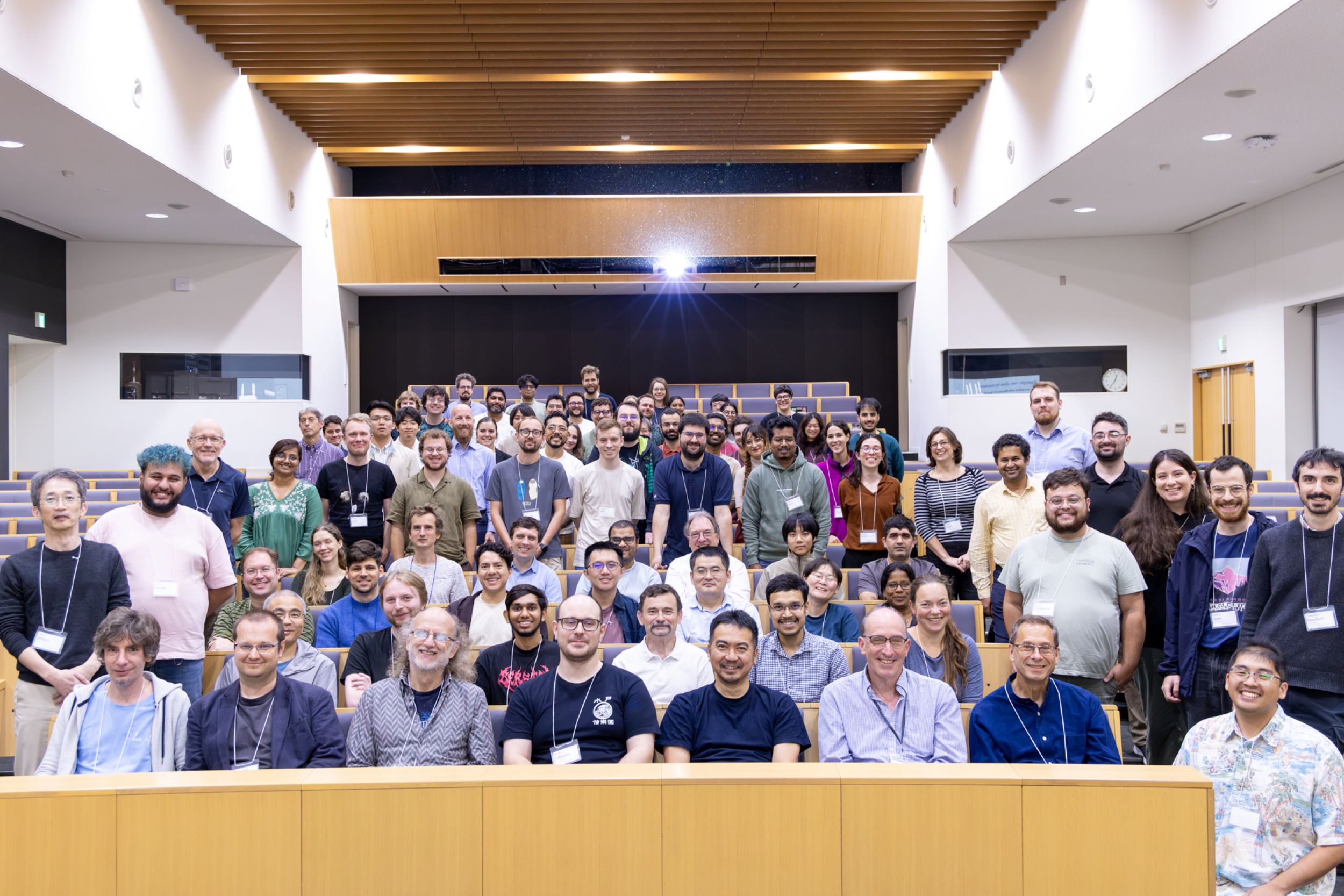
Morning lectures introduced fundamental concepts underlying hadronic decays of beauty and charm, including theoretical approaches and experimental methods, providing a foundation for the afternoon research talks and discussions. Presentations and a dedicated poster session gave early-career researchers opportunities to share their work and exchange ideas with experienced colleagues. A tour of the Belle II detector offered a closer look at the experiment, while an excursion to historic Sawara provided opportunities for informal conversations.
The meeting was organized in collaboration with the KEK Theory Center and received support from the Toshiko Yuasa Laboratory, the Kobayashi-Maskawa Institute for the Origin of Particles and the Universe, and the US–Japan Science and Technology Cooperation Program in High Energy Physics.
Many theorists attended Belle II Physics Week for the first time. Tobias Huber of the University of Siegen praised the meeting’s format: “The concept of having lectures and talks, of giving young people a platform with posters and talks, and of bringing together people from theory and experiment works very well.”
Combining scientific exchange, training, and social activities, the week strengthened connections between theorists and experimentalists and encouraged further collaboration across the community.