- Topics
[Welcome to the IPNS] Interview with Dr. Ahmed Salman MAHMOUD of the Muon and Neutron Group
April 13th, 2026
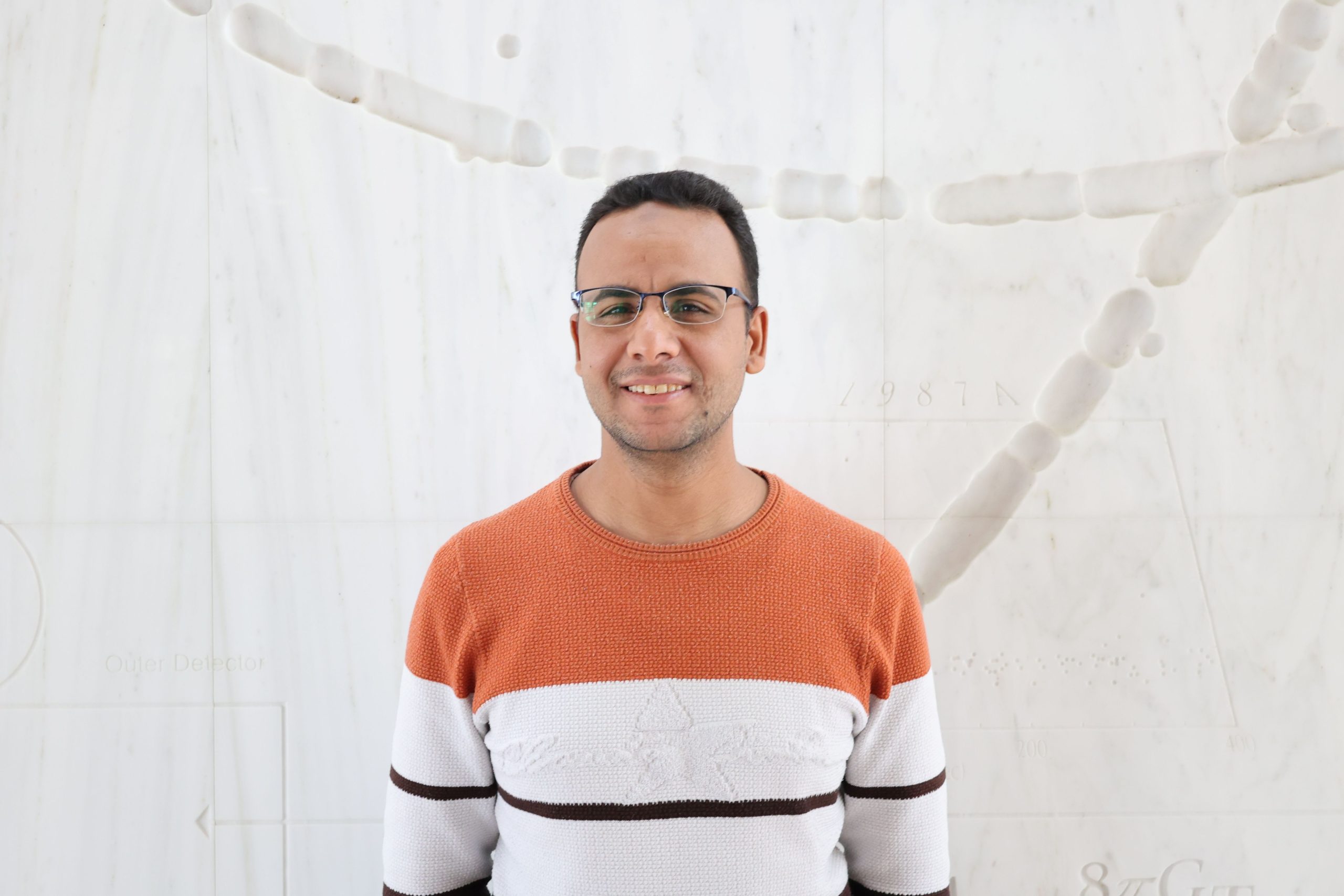
In November 2025, Dr. Ahmed Salman MAHMOUD joined the Muon and Neutron Group at IPNS as a researcher.
We interviewed him about what sparked his interest in the world of particle physics, the research he has conducted, and how he refreshes his mind when faced with challenges in his work.
■What sparked your interest in particle physics?
Childhood curiosity and “Why and How” questions have driven me to be interested in the big questions posed by fundamental physics: what are the fundamental building blocks of the universe? What is the nature of space and time? How did the universe begin? and so on.
■What kind of research were you involved in before coming to KEK?
I did my PhD and Post-Doc studies within the polarized neutron physics group at the China Spallation Neutron Source (CSNS), China. My research activities included studying the polarized neutron science, namely, designing prototypes of the required instrumentation, conceptualizing the polarized neutron experiments and performing the experiments at various beamlines at spallation and reactor-based neutron sources, as well as the consequent treatment and polarization analysis of Time of Flight or monochromatic data.
■What kind of research do you hope to pursue at KEK?
My current research at KEK focuses on developing and optimizing spin analyzers for Neutron Electric Dipole Moment (nEDM) experiment at the TRIUMF Ultracold Advanced Neutron (TUCAN), as well as, simulating and designing of guiding fields system with an adiabatic transition of the ultra-cold neutron polarization along the neutronsʼ path.
■Can you share your method of refreshing your mind when facing difficulties in research and work?
I usually use specific strategies to overcome research ruts and mental fatigue. I break large, daunting tasks into tiny, manageable steps. I talk through my research block with a colleague, friend, or mentor. Explaining a complex problem to someone else often reveals the solution.
We look forward to your future activities at the IPNS!