- Topics
Workshop on the KEK Instrumentation Development Test Beam Line Discusses Development Achievements and Capability Enhancement
July 27th, 2026
-
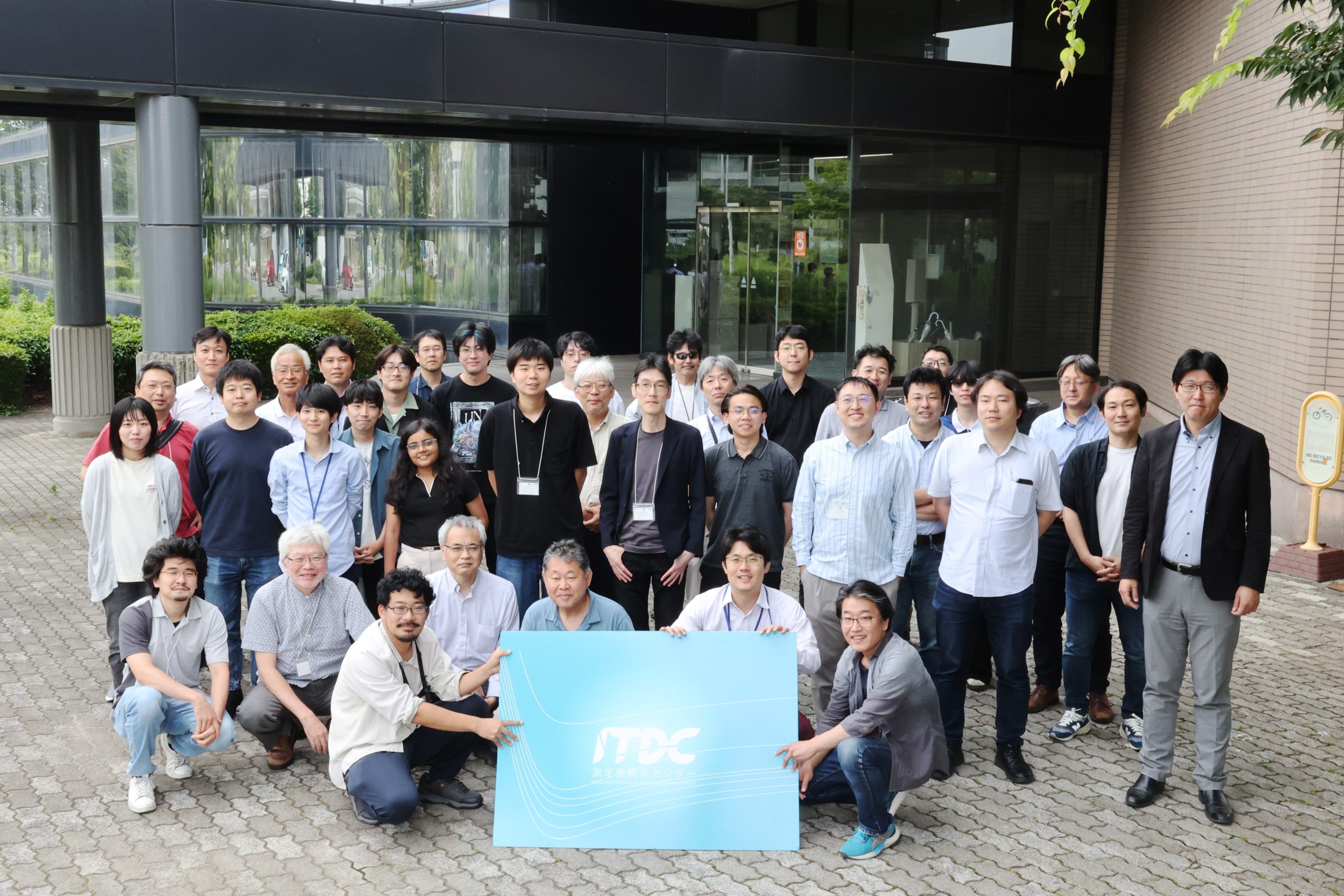
Group photo at the 3-gokan Building
Particle detectors used in particle physics experiments must be evaluated with particle beams before they are deployed in actual experiments. KEK’s Instrumentation Development Test Beam Line is a facility for conducting such evaluations and has been available as a shared-use facility since FY2023.
From June 22 to 24, 2026, the IPNS Workshop “Enhancement of Test Beam Line Capability” was held at the KEK Tsukuba Campus, bringing together 71 researchers, including online participants. The workshop provided an opportunity to share experience gained over the past few years and to discuss future improvements aimed at making the beamline more capable and easier to use.
Test-Beam Experiments Supporting Next-Generation Detector Development Worldwide
The workshop featured numerous presentations by the research groups from Japan and abroad on detector development for both upgrades to ongoing large-scale particle physics experiments and future projects. These included the Belle II experiment at KEK; the ATLAS and ALICE experiments at CERN; the Hyper Kamiokande project under construction in Japan; the proposed Future Circular Collider (FCC-ee) at CERN; and the Electron-Ion Collider (EIC), currently under development in the United States. The presentations highlighted developments achievements and detector performance evaluations carried out using the Instrumentation Development Test Beam Line.
Among the many presentations at the workshop, three examples are highlighted below.
The first report, 2025ARTBL003, addressed testing for the High-Luminosity Large Hadron Collider upgrade at CERN. Researchers evaluated the performance of production ITk pixel modules manufactured in Japan using a 3 GeV electron beam. Under fully depleted conditions, in which particles can be detected across the entire sensor, the modules achieved a detection efficiency of 99.8%. The result demonstrated that the production modules meet the performance requirements of the ATLAS experiment.
The second report, 2025ARTBL013, presented performance tests of a water-target liquid scintillator detector under development for the near detector of Hyper-Kamiokande. The tests demonstrated a light yield seven to nine times higher than that obtained during the first test in 2022. The detector was therefore confirmed to meet the expected performance, marking a major step toward construction of the full-scale system.
The third report, covering 2025ARTBL001 and 2025ARTBL004, presented tests of a dual-readout calorimeter being developed by a Korean group for FCC-ee and EIC. In anticipation of larger-scale test-beam experiments for EIC, participants discussed the required accuracy of the beam energy setting.
-
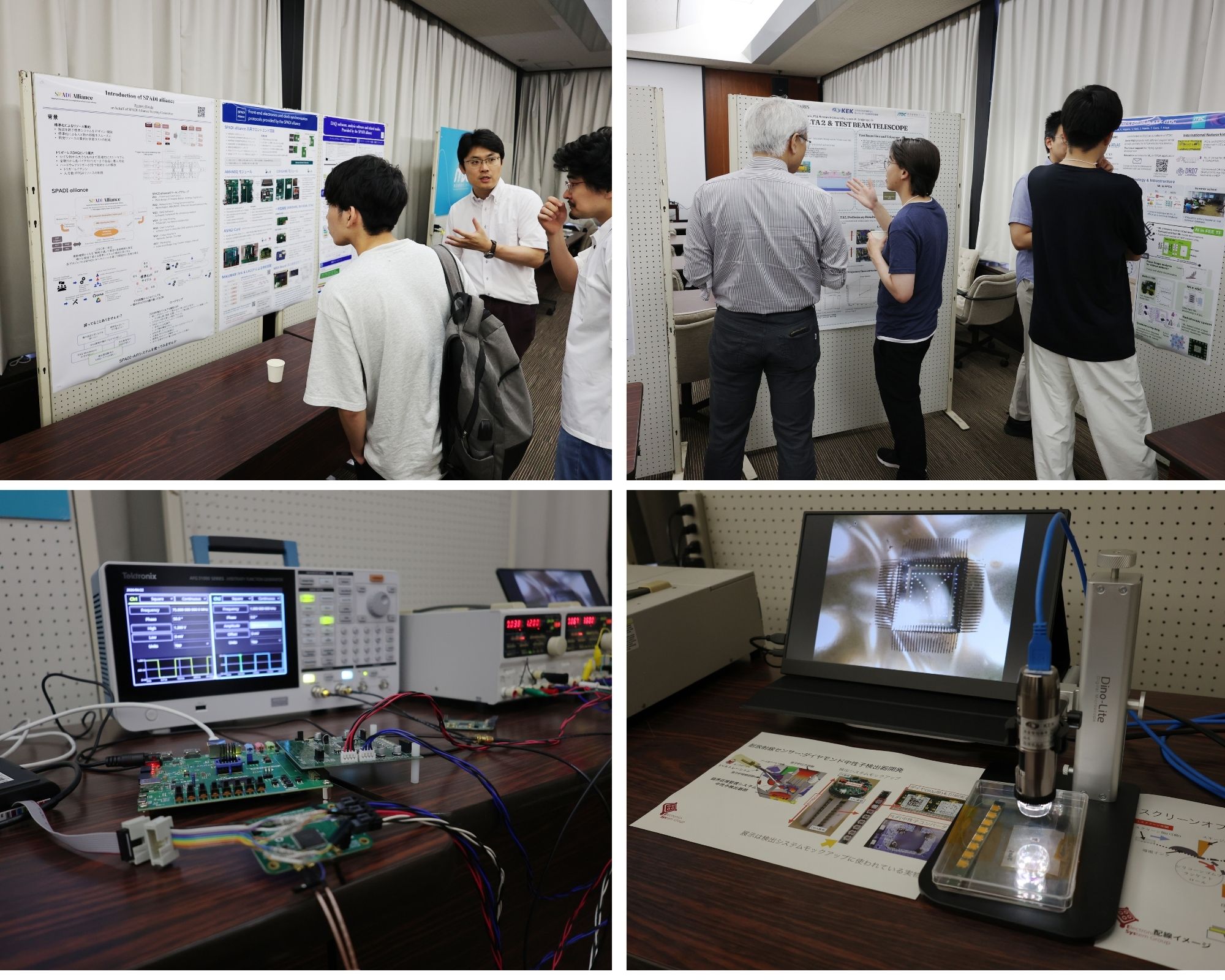
On the evening of the first day, a “Detector R&D Snack Time” session was held, giving participants an opportunity to interact over light refreshments.
Toward Better Usability
KEK Instrumentation Technology Development Center (ITDC) continues to improve the infrastructure and capabilities of the test beam line to make it more convenient for users.
In July 2025, a quadrupole magnet (Q-Magnet) was relocated farther upstream. This increased the beam intensity to approximately 1.4 to 1.8 times its previous level. The measured beam intensity, however, remains below the level predicted by simulations and also fluctuates over time. The underlying causes of these discrepancies have yet to be fully understood. To address these issues, ITDC plans to introduce a system that can monitor and adjust the beam position and size in real time. This will improve understanding of the beam characteristics and support further increases in beam intensity.
A new telescope, an instrument used to track beam particles, is also being developed for completion by the end of 2026. The new system is expected to improve position measurement accuracy. In addition, a permanent magnet will be installed so that the deflection of particles can be measured. This will make it possible to determine both the absolute beam energy and its spread with an accuracy of 1%. The workshop also addressed further improvements to the test environment, including measures to reduce electronic noise.
Yuji Enari, Associate Professor at ITDC and the chair of organizers of the workshop, expressed his hopes for the future as follows:
“Building on the knowledge and challenges shared at this workshop, we will accelerate infrastructure improvements in collaboration with users. These efforts will include introducing a high-precision telescope and automating beam monitoring. As a hub supporting detector development in Japan and abroad, we aim to provide a place where new ideas for the next generation can be put into practice.”