- Topics
[Welcome to the IPNS] Interview with Mr. Junichiro Kato of the Instrumentation Technology Development Center (ITDC)
September 24th, 2026
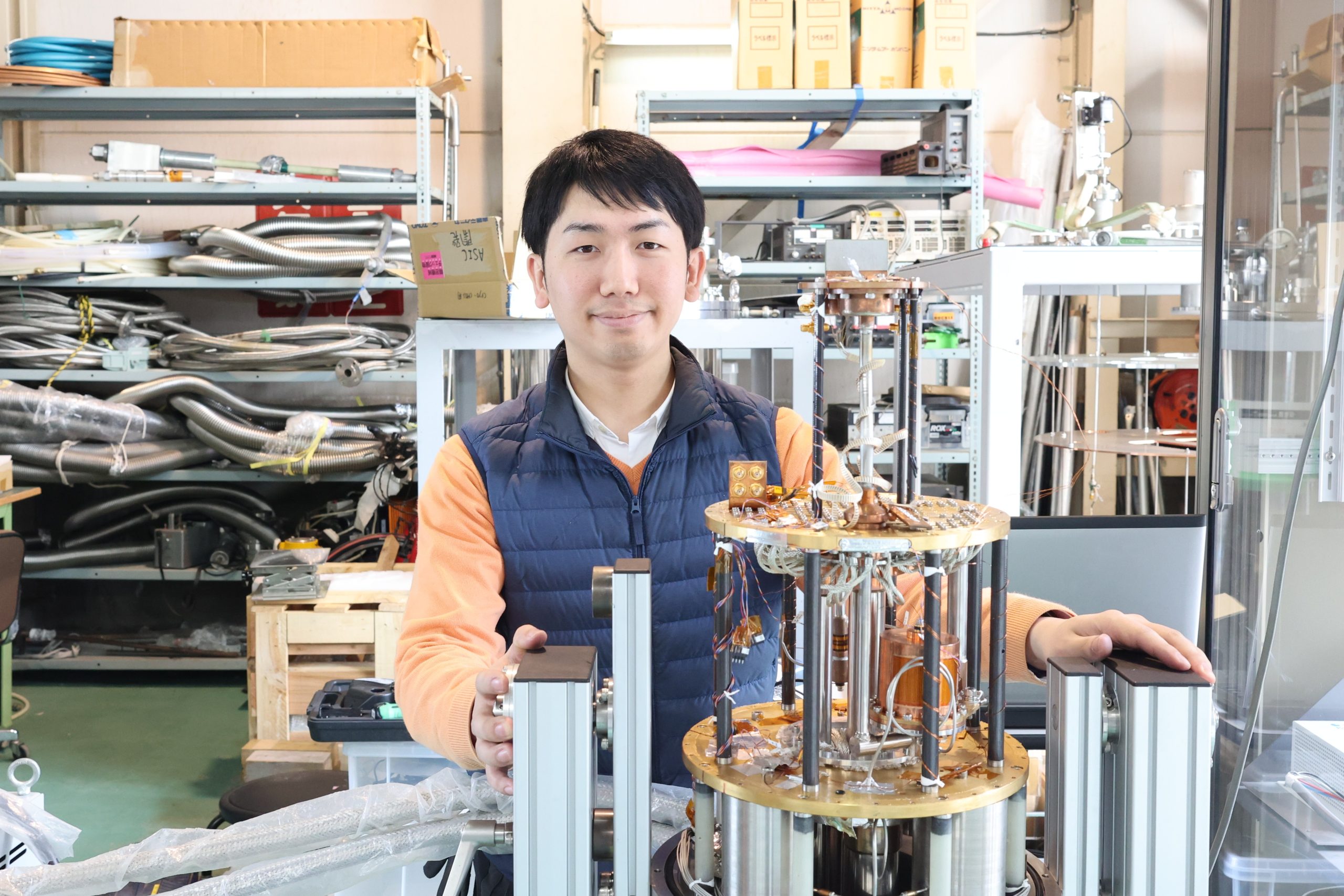
In April 2026, Mr. Junichiro Kato joined the Instrumentation Technology Development Center (ITDC) at IPNS as a technical associate.
We interviewed him about what sparked his interest in the world of particle physics, the research he has conducted, and how he refreshes his mind when faced with challenges in his work.
■What sparked your interest in particle physics?
When Professors Makoto Kobayashi and Toshihide Maskawa were awarded the Nobel Prize in Physics, I was finishing elementary school and preparing to enter junior high school. Watching the news, I was fascinated to learn that everything around us is made up of extremely small particles and that some aspects of the particle world still remain undiscovered. This inspired me to admire the scientists and engineers working in such fields. Having experienced the illness of someone close to me, I developed a desire to help people facing difficulties by contributing to the advancement of science and technology.
I later studied cuprate high-Tc superconductors at Tokyo University of Science (TUS) and the National Institute of Advanced Industrial Science and Technology (AIST). As part of this research, I used the Photon Factory (PF) at KEK, which marked my first direct encounter with both particle accelerators and KEK. Today, I find it both exciting and rewarding to contribute to the advancement of particle physics through research and technological development.
■What kind of research were you involved in before coming to KEK?
Before joining KEK, I was a graduate student in the Department of Physics, Graduate School of Science, at TUS, while also working as a research assistant in the Superconducting Electronics Group at AIST. My research focused on the physical properties of single crystals of cuprate high-Tc superconductors. My work covered the entire process from single-crystal growth and heat treatment to the evaluation of fundamental physical properties. I also participated in domestic and international collaborative studies using scanning, tunneling microscopy and spectroscopy (STM/STS) and angle-resolved photoemission spectroscopy (ARPES), as well as research aimed at applying superconducting materials to terahertz communication devices. In addition, I conducted experiments at large-scale facilities, including the PF at KEK and the High Field Laboratory for Superconducting Materials at the Institute for Materials Research, Tohoku University. Through these activities, I pursued both a fundamental understanding of high-Tc superconductivity and its potential applications.
■What kind of research do you hope to pursue at KEK?
I hope to apply my knowledge of condensed matter physics and superconductivity to the advancement of particle and nuclear physics through detector research and development. More specifically, I would like to contribute to the design, construction, and operation of superconducting magnets for particle physics experiments, as well as to the research and development of the superconducting conductors required for these magnets. I also hope to contribute to the development of next-generation detectors using superconducting materials and devices. By combining my background in materials physics with the expertise in detector, cryogenic, and magnet technologies accumulated at KEK, I hope to help create new directions in research and development.
Technologies developed to support particle physics—including accelerators, superconductivity, cryogenics, and detectors—also have the potential to contribute to materials and life sciences, medicine, industry, and many other areas of society. By collaborating with universities, research institutions, and private companies in Japan and overseas, I hope to contribute both to the advancement of fundamental science and to the wider application of the technologies it produces.
■When you feel stuck with your research or work, how do you refresh yourself?
Spending time exercising, making music, or traveling with my family and friends is the best way for me to refresh my mindset. Physical activity and concentrating on playing a musical instrument help me reset both mentally and physically, allowing me to approach problems again with a calmer and clearer perspective. At times, ideas related to my research or work unexpectedly come to me while I am composing music or experiencing new cityscapes and natural surroundings during a trip. While I value exploring my own area of expertise in depth, I also appreciate the insights that come from interacting with other people and looking beyond the boundaries of my field.
We look forward to seeing his future contributions at IPNS!