J-PARCにおいて高エネルギー加速器研究機構物質構造科学研究所が保有する中性子科学実験装置を用いて行うプロジェクト研究型課題(S1型課題)、装置調整課題、及び、マルチプローブ課題の審査が、2026年1月15日に開催された中性子共同利用実験審査委員会において行われた。S1型課題では課題ごとに審査委員会委員を主査として予備審査(研究会)を事前に行い、主査による評価をもとに審査が行われた。審査結果は今後開催される物質構造科学研究所運営会議で審議される。
◆ 研究成果
d 波タイプ交替磁性体La2O3Mn2Se2の中性子散乱による実験的検証
交替磁性体は、正味の磁化がゼロでありながら時間反転対称性の破れた磁性体であり、特異な電気・スピン輸送特性を示す磁性体として近年注目を集めている[1]。この磁性体ではマグノンの縮退が異方的に解け、異なるカイラリティをもつ2つのマグノンモードが現れることが理論的に予言されている[2]。このようなカイラルマグノンはマグノンスピン流を生成する可能性があり、中でも d 波交替磁性体は、対称性によるスピン流の相殺が起こらず、純粋なスピン流源となり得る。しかし、これまで交替磁性体のマグノンの観測はg 波交替磁性体に限られていた[3,4]。
La2O3Mn2Se2 は、磁性を担うMn2+ イオンが二次元正方格子(図1(a))を形成する磁性体である[5]。この正方格子では最近接相互作用J1の他に、Se2-イオンを介するJ2とO2-イオンを介するJ2'の二種類の二次近接相互作用が存在する。この物質は163 K以下でNéel秩序を示し[5]、d 波交替磁性体が実現する。本研究では、この物質の多結晶試料を用いて J-PARC、MLFに設置された高分解能チョッパー分光器HRCにより中性子非弾性散乱実験を実施し、磁気励起スペクトルを測定した[6]。
実験では主に約30 meV付近に平坦な励起と、Γ'点近傍から立ち上がるマグノン励起が観測された(図1(b))。さらに、前者は40 meV近傍まで高エネルギー側にスペクトルが広がっていることがわかった。このマグノン励起は、J1、J2、J2'を含むスピンハミルトニアンを用いた線形スピン波理論により再現され(図1(c))、反強磁性の最近接相互作用J1 = 2.34(3) meV、二種類の反強磁性二次近接相互作用 J2 = 0.56(2) meV, J
本研究では、d 波交替磁性体のスピンハミルトニアンを初めて実験的に確定したものである。観測されたマグノンのエネルギースケール(約40 meV)とカイラル分裂(約 3 meV)は、スピンゼーベック効果を通じたマグノンスピン流の検出が現実的であることを示唆している。将来的に単結晶試料が得られれば、単結晶中性子散乱によるカイラルマグノンの直接観測やマグノニクス応用への展開が期待される。
本研究成果に関する論文は、Physical Review Materials誌のLetterとして掲載された[6]。
[1] L. Smejkal et al., Phys. Rev. X 12, 031042 (2022).
[2] L. Smejkal et al., Phys. Rev. Lett. 131, 256703 (2022).
[3] Z. Liu et al., Phys. Rev. Lett. 133, 156702 (2024).
[4] Q. Sun et al., Phys . Rev. Lett 135, 186703 (2025).
[5] N. Ni et al., Phys. Rev. B 82, 214419 (2010).
[6] S. Asai et al., Phys. Rev. Mater. 10, L011401 (2025).
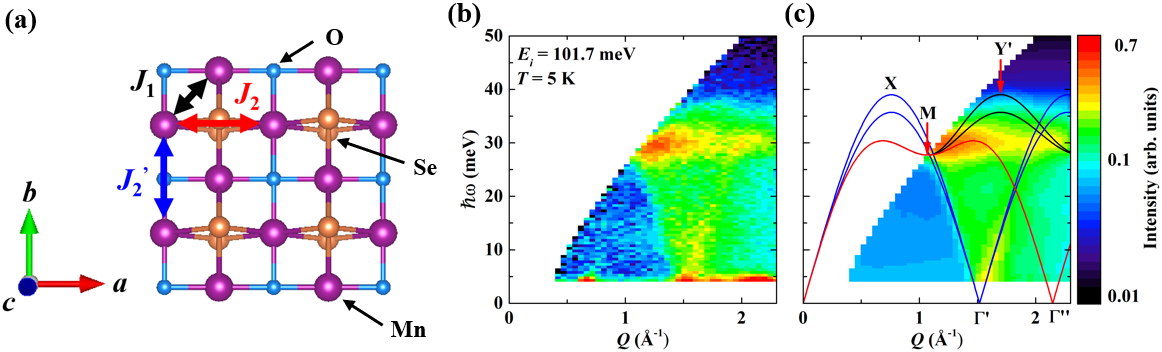
図1.(a) La2O3Mn2Se2の二次元Mn正方格子と主要な相互作用。(b). 測定された粉末中性子非弾性散乱スペクトル。(c). 線形スピン波理論を用いたスピン波励起の計算結果。実線は代表的なマグノンの分散である。記号は代表的な逆格子点の位置である。
Kitaev interaction and proximate higher-order skyrmion crystal in the triangular lattice van der Waals antiferromagnet NiI2
Topological spin textures such as magnetic skyrmions have recently attracted intense interest as emergent states of matter with potential applications in spintronics and quantum materials [1-3]. While most experimentally realized skyrmion systems rely on external magnetic fields or specific non-centrosymmetric crystal structures [1-2], recent theoretical advances suggest that bond-dependent Kitaev interactions can also stabilize higher-order skyrmion crystals in centrosymmetric lattices [4]. In this context, the van der Waals antiferromagnet NiI2 stands out as a promising platform, combining a frustrated triangular lattice, strong spin–orbit coupling, and multiferroic behavior that persists down to the few-layer limit [5-8].
In this work [9], we carried out comprehensive elastic and inelastic neutron scattering measurements to reveal rich static and dynamic magnetic correlations in NiI2 across two temperature-driven phases (TN1 = 75 K, TN2 = 60 K): an intermediate incommensurate phase and a low-temperature multiferroic helix (see Fig.2a). In the paramagnetic regime, characteristic momentum- and out-of-plane–dependent diffuse scattering provides direct experimental evidence for a sizable antiferromagnetic Kitaev interaction. By combining these measurements with semiclassical spin-dynamics simulations and Bayesian parameter optimization, a minimal Kitaev–Heisenberg Hamiltonian is established that quantitatively reproduces the observed excitation spectra over a broad energy and temperature range. This unified description successfully captures both the intermediate-phase excitations and the broadband spin-wave–like response of the multiferroic phase, demonstrating that Kitaev interactions play a central role in shaping the magnetic landscape of NiI2.
Beyond explaining the experimental observations, we used large-scale Monte Carlo simulations with the refined Hamiltonian to find that NiI₂ lies in proximity to a higher-order skyrmion crystal (SkX-2). Although current diffraction and optical probes cannot yet conclusively confirm this phase, the results position NiI2 as one of the most compelling bulk candidates for Kitaev-driven topological magnetism. Looking ahead, targeted real-space measurements, small-angle neutron scattering, and few-layer experiments offer exciting opportunities to directly visualize higher-topological-charge skyrmions and to explore their interplay with multiferroicity in van der Waals materials.
This work was accepted for publication in npj Quantum Materials. One of the time-of-flight inelastic neutron scattering measurements was performed at the HRC beamline under the user program (Proposal No. 2022BU1201).
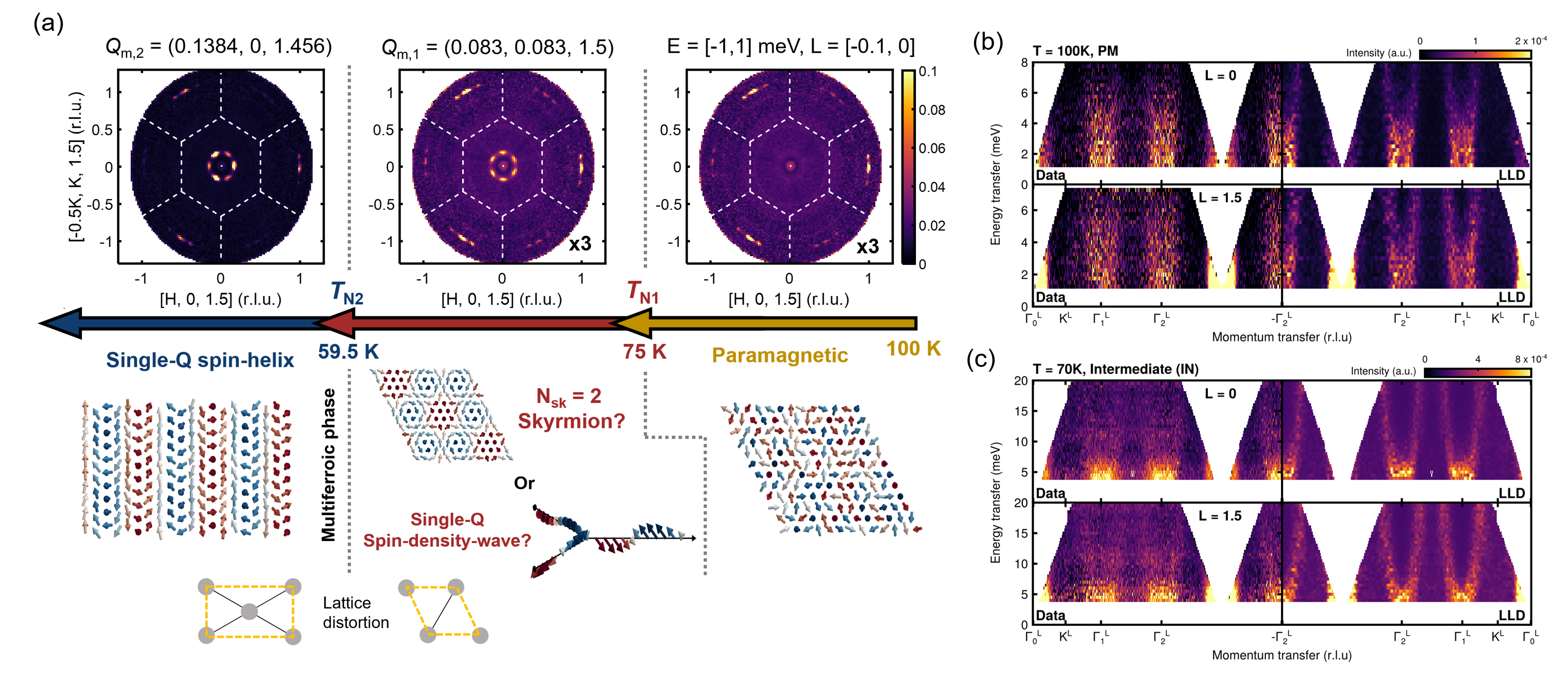
Fig 2. (a) Schematic representation of the magnetic phase transition in NiI2. The upper panels show elastic neutron scattering from NiI2 at T = 100 K (right), T = 70 K (Middle) and T = 4 K (left). The lower panels depict cartoons of the possible magnetic structure in each magnetic phase. (b) Inelastic neutron scattering data (left) and simulated dynamical spin structure factor (right) at T = 100 K. (c) Inelastic neutron scattering data (left) and simulated dynamical spin structure factor (right) at T = 70 K.
[1] A. Fert et al., Nature Reviews Materials 2, 17031 (2017).
[2] N. Nagaosa and Y. Tokura, Nature Nanotechnology 8, 899 (2013).
[3] S. Parkin and S. -H. Yang, Nature Nanotechnology 10, 195 (2015).
[4] D. Amoroso et al., Nature Communications 11, 5784 (2020).
[5] H. Ju et al., Nano Letters 21, 5126 (2021).
[6] T. Kurumaji et al., Physical Review B 87, 014429 (2013).
[7] S. Son et al., Advanced Materials 34, 2109144 (2022).
[8] Q. Song et al., Nature 602, 601 (2022).
[9] C. Kim et al., NPJ Quantum Materials, in press (2026).
◆ 論文等
◆ 論文等
◆ プレスリリース
