◆ 研究成果
Complex magnetic orderings in GdCo2B2
With the increasing focus on green energy, H2 is emerging as an important energy carrier. In order to transport and utilize H2 it needs to be in the liquid state, which is energy intensive to reach. While the first step from room temperature to 77 K can be done cheaply using liquid N2, the remaining 77 K to the liquefaction of 20 K is much more expensive, and there has been a push to develop cheaper methods to do this, such as utilizing magnetocaloric materials. An interesting potential system is GdCo2B2, a member of the ThCr2Si2 family of compounds, which has been shown to have a large magnetocaloric effect near 20 K, the temperature region needed to maintain H2 in the liquid state. In contrast to most magnetocaloric materials, GdCo2B2 relies on a series of antiferromagnetic structural transitions to provide the entropy change. [1] Determining the magnetic structures could potentially open up for a new class of materials to be used for magnetocaloric applications. Doing so, however, would require managing the high neutron absorption of Gd, which HRC at J-PARC has the potential to.
Conventionally a spectrometer, the ability of HRC to select neutron wavelengths by manipulation of the chopper speeds allow for the creation of a monochromatized beam of neutrons. By considering only the elastic data, the instrument can thus function as a diffractometer. The neutron absorption cross section of highly absorbing rare-earth elements is in many cases resonance based, and incidence neutrons with a high energy can reduce the loss to absorption, though this comes at the cost of lower resolution and restricting the Q-range available. Though this allows the use of HRC as a diffractometer to provide data of a quality suitable for model refinements of magnetic structures.
High-energy neutron diffraction measurements were carried out on a powder sample of GdCo211B2 by using HRC at J-PARC. Supporting measurements to determine propagation vectors were carried out on WISH at the ISIS neutron and muon source. Four distinct magnetic structures were discovered, as seen in Fig.1. The first structure was observed at 20 K and consisted of a single component propagation vector of (0.053 0 0). At 16 K the propagation vector shifted to (0.071 0 0), and was joined by a ferromagnetic component. Two propagation vectors were found to coexist at 10 K ((0.0731 0 0) and (0.0731 0.0731 0)) and 6 K ((0.0741 0 0) and (0.0741 0.0741 0)). This bears a strong resemblance to similar systems which contain Skyrmions such as EuAl4 [2] and GdRu2Ge2 [3], and it is possible that topologically protected system exists in GdCo2B2, though it could not be conclusively proven in this study. Exchange interaction energy calculations indicated only small deviations from the ferromagnetic state, and this is likely the reason for large magnetocaloric effect of the antiferromagnetic transitions. It should also be noted that if Skyrmions are demonstrated to exist in this system, it would be interest to consider other topologically protected systems for potential magnetocaloric applications. Especially as similar magnetocaloric properties have been seen in EuAl4. [4]
This work has been published in Physical Review B. [5] The measurements at HRC were performed under the user program proposal numbers 2023A0017 and 2024S01, while the WISH measurements at ISIS were performed through the beamtime RB2420052.
[1] J. Pospíšil et al., J. Phys. Soc. Jpn. 83, 054713 (2014).
[2] [2] M. Gen et al., Phys. Rev. B. 107, L020410 (2023).
[3] H. Yoshimochi et al., Nat. Phys. 20, 1001-1008 (2024).
[4] S. Wang et al., J. Alloys Compd. 968, 171977 (2023).
[5] Simon Rosenqvist Larsen, Noriki Terada, Hiroaki Mamiya, Hiraku Saito, Taro Nakajima, Shinichi Itoh, Pascal Manuel, Dmitry Khalyavin, Fabio Orlandi and Hideaki Kitazawa, Phys. Rev. B. 113, 104411(2026).
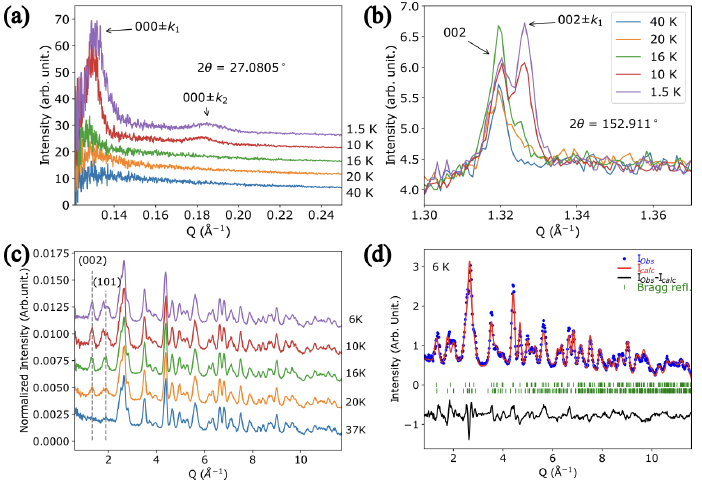
Fig.1. (a) The 000-reflections uncovered by WISH measurements that were used to determine the propagation vectors. (b) The 002 and 002±k-reflections uncovered by WISH, revealing incommensurate structures also present at 16 K and 20 K. (c) Diffraction patterns measured by HRC at the different temperatures. (d) Typical model refinement of the 6 K HRC data using the single propagation vector (0.0741 0 0).
◆ 論文等
◆ プレスリリース
